Heritage Walking Tour Kokoon Hotel Surabaya
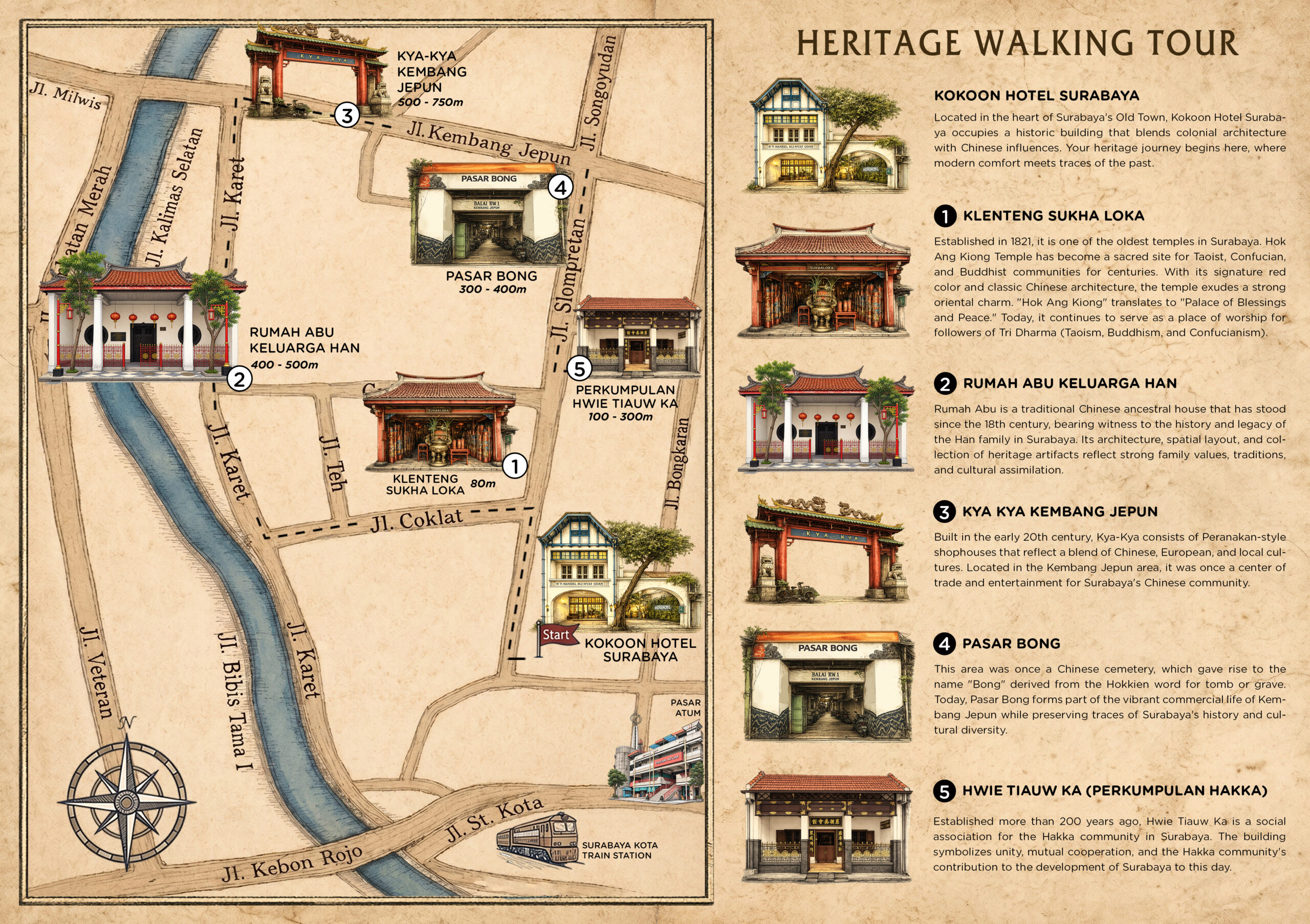
Translation:
| Destination | Description |
|---|---|
| Kokoon Hotel Surabaya Distance: 0m | Located in the heart of Surabaya’s Old Town, Kokoon Hotel Surabaya occupies a historic building that blends colonial architecture with Chinese influences. Your heritage journey begins here, where modern comfort meets traces of the past. |
| 1. Klenteng Sukha Loka Distance: 80m | Established in 1821, it is one of the oldest temples in Surabaya. Hok Ang Kiong Temple has become a sacred site for Taoist, Confucian, and Buddhist communities for centuries. With its signature red color and classic Chinese architecture, the temple exudes a strong oriental charm. “Hok Ang Kiong” translates to “Palace of Blessings and Peace.” Today, it continues to serve as a place of worship for followers of Tri Dharma (Taoism, Buddhism, and Confucianism). |
| 2. Rumah Abu Keluarga Han Distance: 400 – 500m | Rumah Abu is a traditional Chinese ancestral house that has stood since the 18th century, bearing witness to the history and legacy of the Han family in Surabaya. Its architecture, spatial layout, and collection of heritage artifacts reflect strong family values, traditions, and cultural assimilation. |
| 3. Kya Kya Kembang Jepun Distance: 500 – 750m | Built in the early 20th century, Kya-Kya consists of Peranakan-style shophouses that reflect a blend of Chinese, European, and local cultures. Located in the Kembang Jepun area, it was once a center of trade and entertainment for Surabaya’s Chinese community. |
| 4. Pasar Bong Distance: 300 – 400m | This area was once a Chinese cemetery, which gave rise to the name “Bong” derived from the Hokkien word for tomb or grave. Today, Pasar Bong forms part of the vibrant commercial life of Kembang Jepun while preserving traces of Surabaya’s history and cultural diversity. |
| 5. Hwie Tiauw Ka (Perkumpulan Hakka) Distance: 100 – 300m | Established more than 200 years ago, Hwie Tiauw Ka is a social association for the Hakka community in Surabaya. The building symbolizes unity, mutual cooperation, and the Hakka community’s contribution to the development of Surabaya to this day. |